What a profound typology to sit with at the start of Advent. This is one of Scripture's most striking pre-figurations — and Jesus Himself makes the connection explicit.What a rich and luminous topic — and one of the most breathtaking moments of biblical typology in all of Scripture. Let's unpack it fully.
🐍✝️ The Brass Serpent: A Pre-figuration of Christ on the Cross
📖 The Event: Numbers 21:4–9
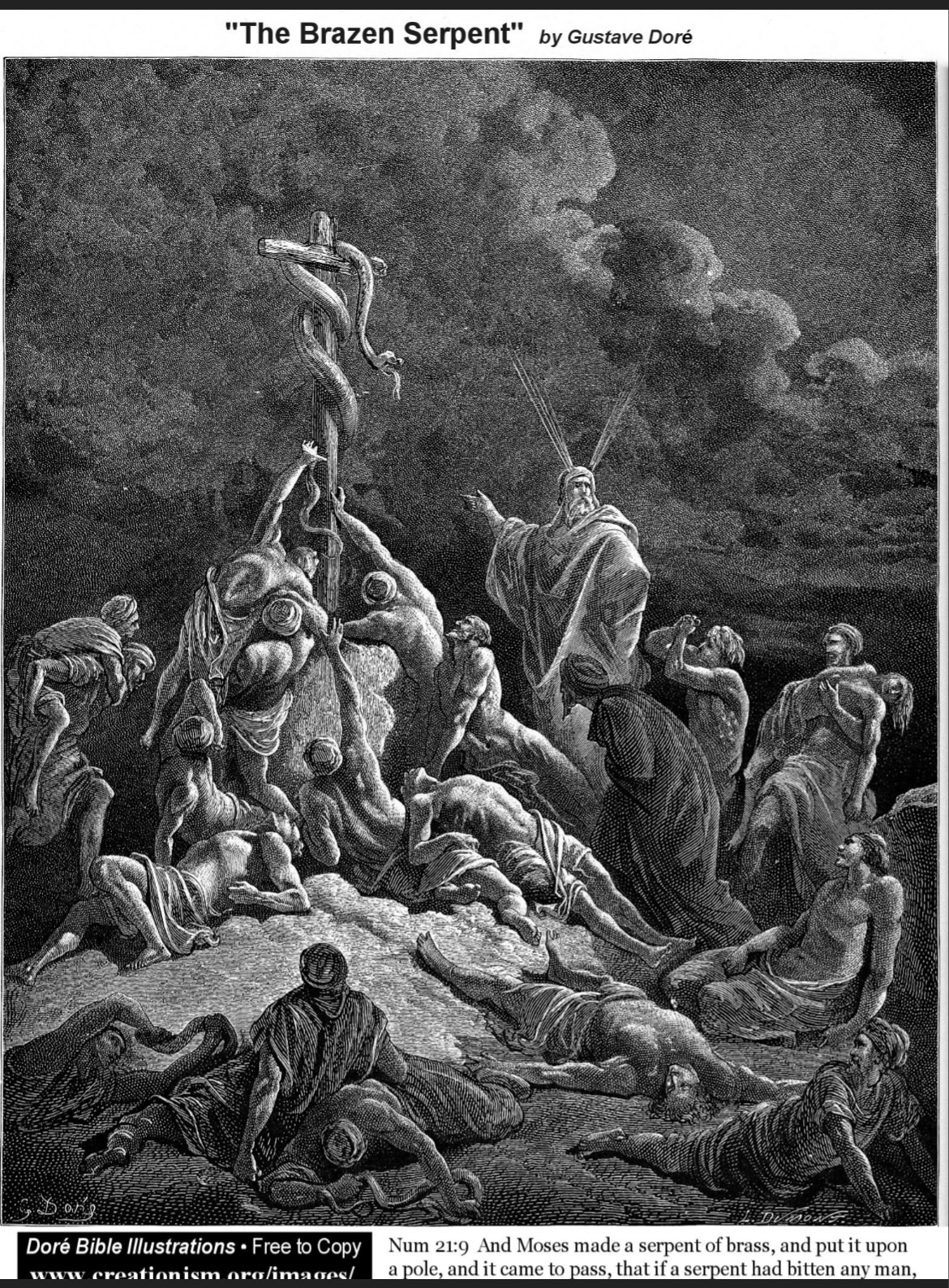
In Numbers 21:4–9, when the Israelites were suffering from deadly snakebites in the wilderness, God instructed Moses to forge a bronze (or brass) serpent and mount it on a pole. Anyone who was bitten could look at the elevated bronze snake and be healed.
The pattern here is devastatingly clear:
- Sin → the people complained against God and Moses
- Judgment → fiery serpents came among them
- Repentance → they cried out for intercession
- Salvation → God provided a visible sign: look and live
The Church reads this passage as a key moment in salvation history, where divine judgment, mercy, repentance, and healing converge.
✝️ Jesus Makes the Connection Himself — John 3:14–15
This isn't a typology invented by later theologians. Jesus draws the line directly. In His famous conversation with Nicodemus, He says:
> "And as Moses lifted up the serpent in the desert, so must the Son of Man be lifted up, that whoever believes in him may have eternal life." (John 3:14–15)
Jesus's own words provided unassailable warrant for reading Numbers 21 typologically. If Jesus Himself interpreted the bronze serpent as prefiguring His crucifixion, then this typology possesses maximum authority.
Christ identifies the lifting up as His crucifixion (John 12:32–33). The context matters: the promise of eternal life to those who believe is grounded in the typological argument from Numbers 21.
🔍 The Deep Layers of the Typology
This pre-figuration is extraordinarily precise. Consider the correspondences point by point:
1. The Serpent's Form Without Its Nature
The bronze serpent had only the form of a serpent but not the nature of a serpent. Therefore, the bronze serpent is a type of Christ, who had the form, the likeness, of the flesh of sin — but not the sinful nature of the flesh of sin.
This is St. Paul's language in Romans 8:3: God sent His Son "in the likeness of sinful flesh." Christ looked like what killed us — He took on our humanity, our mortality, our vulnerable flesh — without being contaminated by sin. The serpent on the pole looked like the deadly serpent, but it carried no venom.
2. The Lifting Up
Christ pronounces the bronze serpent to be a type of Himself. Both are lifted up: that one on a pole, this One on the Cross.
The Greek word used in John 3:14 — hypsōthēnai — means both "to be lifted up" physically AND "to be exalted." The Cross is simultaneously the moment of Christ's greatest humiliation and His greatest glorification. The Cross looks like defeat; it is victory.
3. The Act of Looking in Faith
Just as anyone in the desert who looked upon the bronze serpent with faith was saved, so too anyone who looks with faith upon Jesus and His Cross will be saved.
The bronze serpent had no power of its own — it wasn't magical. Its power came from the fact that it was a sign of faith and the providence of God.
This is crucial: God does not reward passivity. He calls for an active, deliberate gaze of faith. The Israelite who refused to look, died. This is not arbitrary — it mirrors the reality that those who refuse to look upon Christ crucified and believe remain in their sin.
4. Healing Through the Instrument of Death
The bronze serpent is a clear Old Testament type of Christ crucified. The serpent, a symbol of sin and death, is transformed into an instrument of healing when lifted up — just as Christ, who knew no sin, becomes sin for us upon the Cross.
Just as God decreed to redeem through man those whom man had lost, and to repair through wood the damage proceeding from wood, so He decreed to heal the evil inflicted by serpents through the likeness of a bronze serpent.
This is the divine logic of the Incarnation and the Cross: God consistently uses the very instrument of destruction as the instrument of salvation. The wood of the forbidden tree becomes the wood of the Cross. The form of the deadly serpent becomes the sign of healing.
🏛️ What the Church Fathers Say
St. Augustine taught that the bronze serpent signifies Christ's death on the Cross — for as the serpent brought death, so Christ's likeness to sinful flesh brings life to those who look in faith, healing the wounds of sin.
Cyril of Alexandria emphasized the serpent as a symbol of victory over evil, where looking upon it prefigures believers gazing at Christ crucified to conquer the devil's poison.
The ancient Epistle of Barnabas (one of the earliest Christian writings) records: "Moses made a serpent of brass and set it up conspicuously, and called the people together, and when they were assembled he said, 'The Lord God shows that you shall be saved in this way.'"
⚠️ A Warning Embedded in the Type: Don't Worship the Sign
Here is a sobering footnote to this typology. King Hezekiah later destroyed the bronze serpent — called Nehushtan — because the Israelites had begun burning incense to it (2 Kings 18:4). If the bronze serpent prefigured Christ, how could it become idolatrous? The Church Fathers resolved this by distinguishing between legitimate typological use (looking for healing as God commanded) and illegitimate idolatrous worship (offering sacrifices to it).
The sign was always meant to point beyond itself. When people began worshiping the sign instead of the God it signified, it had to be destroyed. This is a permanent lesson: no sacramental, no image, no devotion exists for its own sake. Everything in the economy of salvation points to Christ.
🌿 Why This Matters Now, in Advent
Advent is a season of waiting and looking forward. The bronze serpent is the perfect Advent image: a people wounded by sin, dying in the wilderness, being invited to look up at a sign hung on a pole — and live.
The entire Old Testament is Israel learning to look up. At Christmas, what they were looking toward arrives. The bronze serpent in the desert is answered by the Infant in the manger — and fulfilled completely when that same flesh is lifted up on Calvary.
The gaze of faith that healed the dying Israelite is the same gaze of faith that saves a soul today. Look at the Cross. Believe. Live.
The bronze serpent teaches that God has always been willing to use what kills us as the very thing that saves us. Knowing that, what in your own life — a wound, a failure, a burden — might God be inviting you to bring before the Cross this Advent, trusting that the instrument of suffering can become an instrument of grace?