What a beautiful and moving question. The death of St. Joseph — called the transitus — is one of the most tender mysteries in all of Sacred Tradition. Here is the full picture, drawing from Scripture, Tradition, and theology.
🤫 The Silence of Scripture
There is no mention of Joseph after he and Mary find the twelve-year-old Jesus in the Temple (Lk 2:42). St. Joseph is not found in any of the other New Testament books, including the Letters of St. Paul or the Acts of the Apostles.
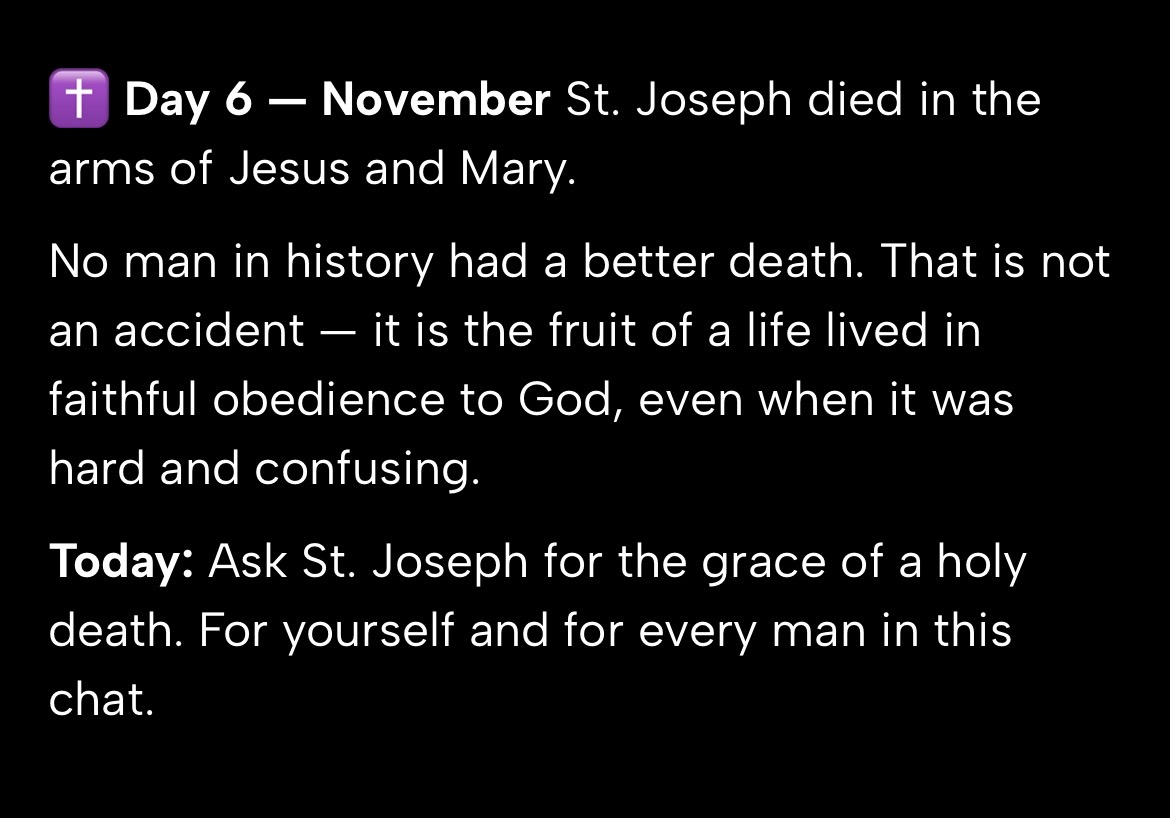
Yet Christian tradition has always affirmed two facts with remarkable consistency: Joseph died before the public life of Jesus, and he died in the most desirable way there is — attended by Jesus and by Mary.
🔍 The Clues Scripture Leaves Behind
Scripture's silence is itself evidence. At the wedding at Cana the mother of Jesus is present (Jn 2:1), but not his father. In no scene of the public life, on no journey, in no controversy does Joseph appear, nor is he ever addressed.
Joseph is absent from the entire public life, the people of Nazareth call Jesus the son of Mary (Mk 6:3), and on the cross Jesus entrusts his Mother to the beloved disciple (Jn 19:26-27), a gesture that presupposes that Mary was already a widow. Had Joseph been alive, it would have been his duty — not the beloved disciple's — to care for her.
✝️ The Tradition of the Transitus
If Joseph died during the hidden years, he died in the house where the Holy Family lived — and therefore he died with Jesus and Mary at his side. Christian piety has always emphasized what this means: no other human being ever breathed his last attended at the same time by the Son of God and by his Immaculate Mother.
Some time before Christ began to preach publicly the good news of salvation, Joseph died, assisted and comforted by the loving presence of Jesus and Mary — a death that was later to become the cherished ideal of all Christians.
The tradition also carries a beautiful theological logic: Tradition has always believed that it was necessary for Joseph to disappear from the scene or he would have been an obstacle to the preaching of Christ. Think how confusing it would have been for Christ to be preaching about His heavenly Father if Joseph were close at hand! There is every reason to suspect that the multitudes would have thought He was speaking about Joseph. In order to obviate such difficulties, the early death of Joseph was convenient. Joseph had to decrease that the kingdom of God on earth could increase.
📖 The History of Joseph the Carpenter
The History of Joseph the Carpenter, an apocryphal writing, offers detailed but non-canonical accounts of his death. This text claims St. Joseph died at the age of 111, surrounded by Jesus and Mary. It describes his death as peaceful, with Jesus comforting him and promising eternal life. While these details are vivid, the Church does not regard this text as inspired Scripture.
This intuition has run through Christian art — the countless paintings of the transitus show Joseph on his deathbed, between the Son who blesses him and the Spouse who keeps watch over him.
⚰️ Burial
The location of St. Joseph's burial is unknown. The Venerable Bede claimed he was buried in the Valley of Josaphat. St. Jerome believed it was in the Garden of Gethsemane. However, it is more likely that he died and was buried in Nazareth, where the family lived when Jesus was a youth.
🙏 Patron of a Happy Death
From the transitus comes the title Patron of a Happy Death, which the Catechism expressly takes up when it exhorts the faithful "to entrust ourselves to Saint Joseph, the patron of a happy death" (CCC 1014).
For the Christian, a happy death is not a death without pain but a death in grace: in communion with Christ, reconciled with God, sustained by the prayer of the Church. Joseph embodied the archetype of such a death — according to tradition, he breathed his last with his hand in the hand of Jesus and under the gaze of Mary.
In the traditional reading, the hour of death is the hour of the final assault. Hence the same saint is invoked, in two consecutive lines, as the support of the one who is departing and as the terror of those who would hold him back.
✨ What This Means for Every Soul
Joseph is the patron saint of the dying because, assuming he died before Jesus' public life, he died with Jesus and Mary close to him — the way we all would like to leave this earth.
The graces available on Joseph's deathbed are available to us on our deathbed, especially through holy Viaticum — the reception of Holy Communion by a sick person on their deathbed.
St. Joseph's life was one of righteousness — Scripture leaves us with the most important knowledge of who he was: "a righteous man" (Matthew 1:18). And that righteousness reached its fullest expression in his final breath — held in the arms of the Word Made Flesh and the Immaculate Mother of God.
There is no death in human history more consoling to contemplate. Joseph, the silent, faithful, working man — cradled at the end by the very Jesus he had cradled as an infant in Bethlehem.
Something worth sitting with: If you knew that Jesus and Mary would be with you in your final moments the way they were with Joseph, what would change about how you live today — and how you think about death?
Explore this topic and many more by downloading Truthly