Revelation 12:7–12 — Verse by Verse
This is one of the most theologically rich passages in all of Scripture. Here is the full text (NABRE), followed by a careful, Catholic unpacking of each movement.
The Text
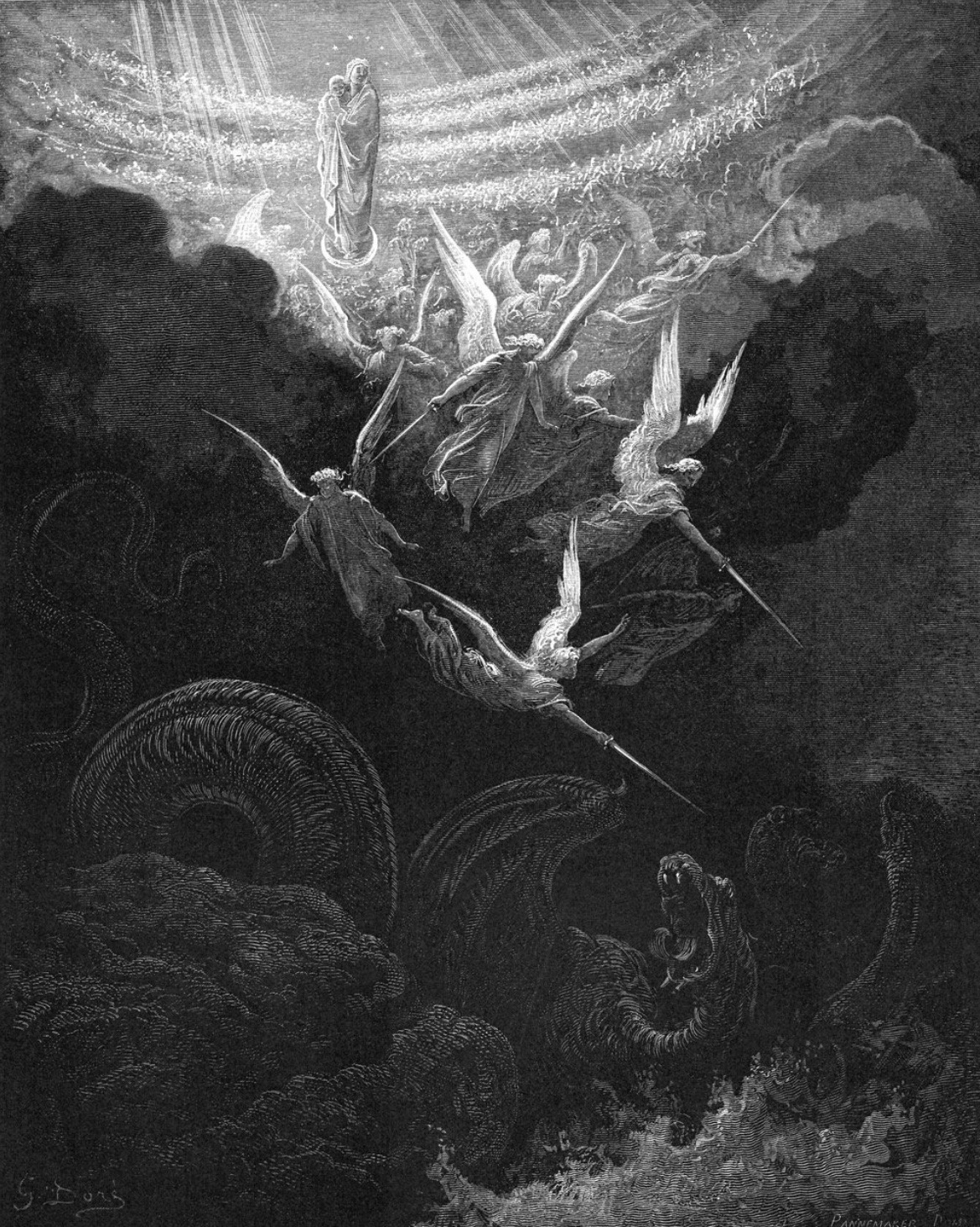
Verse 7: "Then war broke out in heaven; Michael and his angels battled against the dragon. The dragon and its angels fought back,"
Verse 8: "but they did not prevail and there was no longer any place for them in heaven."
Verse 9: "The huge dragon, the ancient serpent, who is called the Devil and Satan, who deceived the whole world, was thrown down to earth, and its angels were thrown down with it."
Verse 10: "Then I heard a loud voice in heaven say: 'Now have salvation and power come, and the kingdom of our God and the authority of his Anointed. For the accuser of our brothers is cast out, who accuses them before our God day and night.'"
Verse 11: "They conquered him by the blood of the Lamb and by the word of their testimony; love for life did not deter them from death."
Verse 12: "Therefore, rejoice, you heavens, and you who dwell in them. But woe to you, earth and sea, for the Devil has come down to you in great fury, for he knows he has but a short time."
Verse-by-Verse Catholic Commentary
Verses 7–9: The War and the Expulsion
Michael, mentioned only here in Revelation, wins a victory over the dragon. Michael is the archangel, guardian and champion of Israel, referenced also in Daniel 10:13, 21; 12:1; and Jude 9. In Hebrew, the name Michael means "Who can compare with God?" — a declaration hurled against Satan's pride, answering the lie that any creature can rival the Creator.
The dragon is identified as "the ancient serpent" who seduced Eve (Genesis 3:1–6). "Was thrown down" is an allusion to the expulsion of Satan from heaven, echoed in Luke 10:18.
The war in heaven results in the expulsion of Satan and his angels to earth, marking the beginning of their attempt to destroy Christ's followers.
The fall of Lucifer from heaven, with the rebellious angels, is driven by St. Michael. This is not a defeat that catches God off guard — it is the unmasking of a rebellion that was always destined to fail.
Verse 10: The Accuser Is Cast Out
The word "accuser" is the very meaning of the Hebrew word "Satan," found also in Job 1–2, Zechariah 3:1, and 1 Chronicles 21:1 — where he continues to accuse Christ's disciples.
Satan's role as accuser is not merely legal fiction — it is the core of his strategy against the human soul. He reminds God (and us) of our sins constantly. But this passage announces that his power to accuse has been broken. Satan's accusation against the brethren is undone by the blood of Christ. This shows how salvation through Jesus Christ defeats the forces of evil and ensures final victory for God's people.
Verse 11: How They Conquered
This is the verse that strikes at the heart of every Christian's vocation. Christ conquers through His death and resurrection, bringing victory over Satan and offering salvation to the faithful.
The faithful conquer in Him — through three things:
1. The blood of the Lamb — the saving power of the Eucharist and the Cross
2. The word of their testimony — courageous proclamation of the faith
3. Not clinging to life — martyrdom, the ultimate act of spiritual freedom
This is not passive. This is warfare of the highest order.
Verse 12: The Double Edge
Heaven rejoices. Earth is warned. The Devil has come down in great fury, for he knows he has but a short time.
This is critical: Satan's expulsion from heaven is not the end of danger — it intensifies the battle on earth. His fury is the fury of a defeated general who knows the clock is running out. Although the Church is protected by God's special providence, the individual Christian is to expect persecution and suffering.
The Broader Context
This central section of Revelation portrays the power of evil, represented by the dragon, in opposition to God and His people. First, the dragon pursues the woman about to give birth, but her son is saved and caught up to God and His throne. Then Michael and his angels cast the dragon and his angels out of heaven. After this, the dragon tries to attack the boy indirectly by attacking members of His Church.
The Woman of Revelation 12 carries a richly layered meaning. Like many of the other visions in Revelation, this one has multiple levels of meaning. On the one hand, the woman symbolizes the faithful people of God of the Old and New Testaments. On the other, she is Mary, the Mother of the Messiah, and for that reason the most exalted member of the human race after her Son.
The Takeaway
This passage is not mythology. It is the map of the spiritual life. Michael wins the battle in heaven. The martyrs win the battle on earth — through the Cross, through testimony, and through surrender of life itself. The accuser has been thrown down. His time is short. The question for every Christian is whether they are living like people who believe that.
Here is the question worth sitting with: Verse 11 says the faithful conquer by the blood of the Lamb, the word of their testimony, and by not clinging to life — which of these three is the hardest for you personally, and what might God be asking you to surrender in that area?