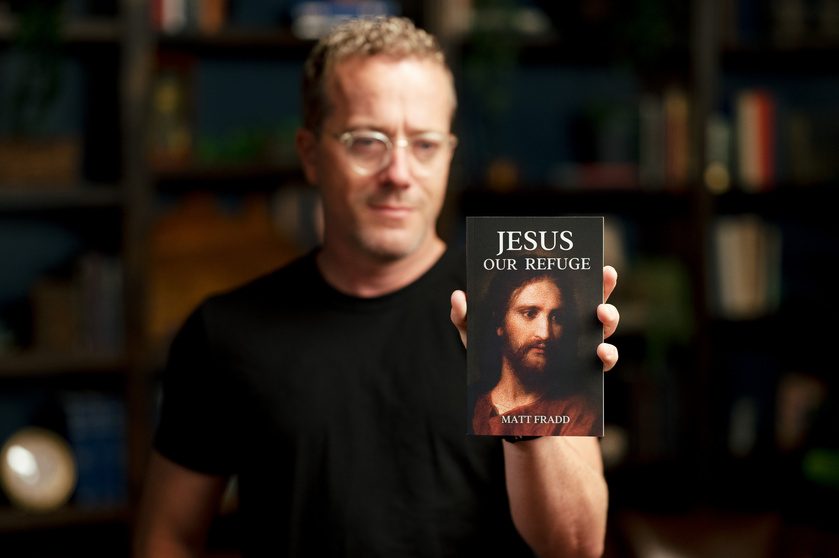
I thought I’d post my book talk in case anyone was interested:
When I was younger, I’d overhear daily greetings between old timers, and they would go something like this,
“How ya doing, Bob?”
And I’d hear something like, “Can’t complain. No one wants to hear it!”
I’d hear a chuckle with a response of, “Ain’t that the truth?”
I found it a little morbid, but we’d all chuckle together, eventually, because that’s how we solved our problems back then, with jokes, and lots of ‘em! After all, if you don’t laugh, you’ll cry. As I got older, I realized there was something else hidden in those exchanges. Beneath the punchline was a quiet acknowledgment of suffering. They weren’t really saying, “Nobody wants to hear it.” They were saying, “Life is hard, and we’re carrying it together.”
And that’s where advocacy begins.
Disability advocacy is not standing at a podium and shouting at people, not always anyway. Christian advocacy, or what we call evangelization, is definitely not that. Instead, it starts with vulnerability. It starts with the courage to say help. It starts with patience and understanding, knowledge and fortitude, gentleness and love.
Every Catholic in the room is thinking right now, ‘Wait…this sounds familiar. I’ve heard this grouping of words before…’
In the book of Isaiah, we hear about the gifts of the Spirit and in Galatians, Paul writes about the fruits. In reality, I doubt we ever think of them as real gifts, the way we wish for cash or a new bike. That’s because the fruits and gifts of the Holy Spirit don’t feel like fruits and gifts until you’re desperate to receive and practice them.
When you’re stuck in traffic, realizing you’re not going anywhere in the next hour, you might just ask God for the patience to sit and do nothing and trust the traffic jam will resolve soon.
When you need to speak up about an injustice happening before your very eyes, you might just ask the Spirit for the courage to go against the crowd and utter one word.
When you don’t want to hurt someone with your approach, but correction is still necessary, you might take a deep breath and wish for gentleness.
This is what it means to have faith. This is what it means to find joy amid suffering, because if you can handle a tough situation using these fruits and gifts, you might find peace on the other side. And the wildest part is how you won’t suddenly achieve perfection. There will be mistakes and bruises, no doubt. But if you persevere, you may achieve the outcome you hoped for all along. That’s when we realize these fruits and gifts are the path to true goodness. And it is in goodness where God likes to set up shop and work wonders through us.
If I’m honest, I had no idea what I was doing when I began to write this book, but I think that was kind of the point. Something in me persisted though and said, “Keep going.” I followed that voice. So, I told a story that risked being vulnerable. I told it so that people could see the pain, isolation, and loneliness of those with hearing loss. There were a lot of bruises and mistakes. There was even more medical jargon. I was so confused… well, I’ll let you be the judge of how I handled it.
This is an excerpt from my book. I hope you like it.
[The doctor tells me he’s not sure why I went deaf but] confirms the presence of Advanced Otosclerosis, though he notes that profound deafness is rare…
[His] explanation of the surgery is clinical. A small magnet and computer chip will be placed under my scalp. Internally, an electrode wire, the size of fishing thread, will bypass my middle ear and feed directly
into my cochlea. The wire will zap the auditory nerve, taking the place of atrophied cilia, the hair-like structures that normally transmit sound. The internal, magnetized piece will sit just beneath the skin, communicating with my external processor and collecting sound through microphones anchored onto my ears.
I sit still, absorbing every detail. I tell him how grateful I am, not just for the procedure itself, but for his transparency. It’s nice to have a qualified medical expert acknowledge that they don’t know why I
went completely deaf. For the first time in almost a decade, I’ve just put down a bag of bricks I didn’t realize I was carrying.
The next day, the hospital calls to schedule my surgery for September 17th. I ask them to follow up with an email; I’m not sure I’m
catching everything correctly over the phone.
I’m told I’ll need to take 3-5 days off from work. There might be some balance issues, mild pain, and a little blood, pooling around my ear, causing discomfort. After the procedure, I’ll have no natural
hearing left [in my right ear], but they reassure me it won’t matter.
[My hearing] is so minimal now that I won’t notice.
A month later, they’ll provide the processors. At that appointment, the implant will be activated. I’ll need to return for follow-up adjustments, but they tell me I should see a dramatic improvement
in my hearing within the first three months. Softer sounds will come later, and by the end of the first year, I should be able to understand most speech. After that, they’ll consider a second cochlear implant
for my left ear.
I [go home] and pull up a picture of what patients look like after the surgery.
There are bandages wrapped around the head with a round, bowl-like structure covering the ear. It makes my stomach feel queasy. I say a prayer to center myself.
If I can summon courage, maybe I can find my way back. Tears well up as I think of how much I miss music, the sound of a play,
and poetry read aloud. In that moment, I make a promise to myself:
I will do anything to hear again. The distant memories of what is good, true, and beautiful are too powerful to ignore. I will hope for mire, no matter what this life throws my way.
I read stories about veterans who return from war, missing limbs, yet they still climb mountains, build communities, and impact the world. I need to keep reading those stories. I need to find faith in the
example of my fellow humans and their suffering. Maybe [Nietzche’s] abyss
isn’t a monster after all. Maybe it’s where courage is forged. If there’s
one thing I know about myself, it’s that I’m courageous.
And I’ve got to keep telling myself to fight. I must fight the darkness, the silence, the pull of the abyss. It’s so tempting to give up, to step back from the edge and give up. It’d be so easy to quit [on life itself], to make excuses and not go through with this surgery, but I won’t.
I won’t give up, because there are people who rely on me. My existence brings comfort to others. I won’t give up, because I’m good at what I do when I can understand the needs of those around me. I
won’t give up, because I will love again, the way God wants me to love. I won’t give up, because I’m not a coward. I won’t stop trying, because I am loved.
Even in my darkest hours, I won’t give up.
I am here.
I am here.
I am here.
... even if I cannot hear.”
The subtitle of my book [A Woman’s Surrender to the Still, Small Voice], should sound familiar to anyone who knows the story of Elijah. I love that recent meme about him. It says something like, “Remember, when Elijah wanted to give up and die, because no one was listening to him and, God in his infinite wisdom was like, “Why don’t you eat a snack and take a little nap? You’ll feel better soon, I promise!” How many times are we just exhausted, or hangry and we think the world is ending? I used to teach preschool, so I often look at adults and think, “You need a time out,” but the interesting thing is that I should probably say it more to myself than anyone.
Throughout those silent years, I kept thinking about hearing God, not in the wind or earthquake or fire, but in the still, small voice. And I remember thinking:
What if God is still speaking, even here? What if being unable to hear the world clearly could somehow deepen my ability to listen, spiritually? I don’t mean that suffering suddenly became beautiful or easy. It didn’t. Obviously, there were moments of real despair. Moments when I felt broken, isolated, and exhausted. But I slowly began to understand something important: my worth was never dependent on my ability to hear perfectly. God was still present in my limitations. He was still there in my exhaustion. He is still here in the silence. And he enters our lives quietly like that, not as a dramatic triumph but as the gentle refusal to let us disappear.
And that’s how he saves us.
I think that's why I wrote this book. Not because I have every answer about suffering, but because I know there are people carrying invisible griefs who wonder if anyone sees them, hears them, or understands what they’ve lost.
I want to say:
you are not forgotten.
You are not alone.
And even in silence, there is still hope.
You are here.
You are here.
You are here.
… even if you can no longer hear… because your story isn’t over yet.
Last month, the moment my book was published, a woman in Australia read it. She reached out to me on facebook messenger and asked me when I was going to write my next book. And will it be about hearing loss too? Will I continue to write about this topic and represent this issue and continue the advocacy? My very first reader, from the other side of the world, said all of that! I guess I’m not finished any time soon, huh?
We never know what is possible until we say Yes to life and God’s plans for us. But, first, we have to listen, and most of the time, he speaks to us in the still, small voice.
Will you listen for what God has planned for you?
Thank you.